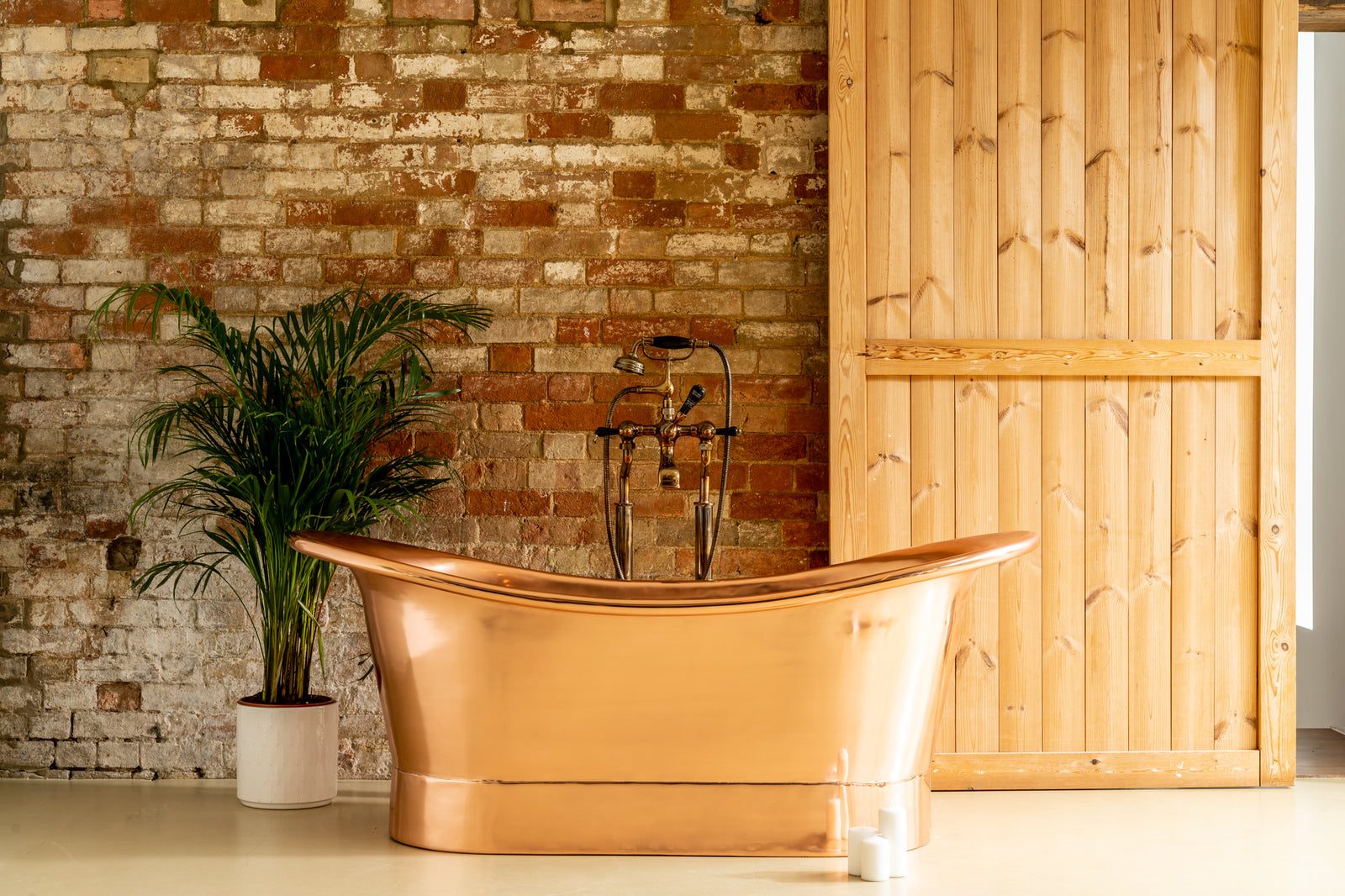





English bathroom faucets have a character that extends beyond traditional styling.
Carefully proportioned spouts, substantial Brass components, cross handles, ceramic levers and hand-applied finishes can give a faucet a sense of permanence that is difficult to achieve with mass-produced bathroom fixtures.
For American homeowners, architects and interior designers, traditional English faucets can introduce warmth and craftsmanship into bathrooms that might otherwise feel overly new or uniform.
At Rutland London, our Luxury Bathroom Faucets & Showers are designed for traditional, transitional and contemporary interiors, with products made and finished in England and available across an extensive selection of Brass, Bronze, Nickel, Copper and Gold finishes.
This guide explores how to choose English bathroom faucets for an American home, including widespread faucets, wall mount and deck mount designs, cross handles and levers, bathroom sink and bathtub fittings, shower coordination, plumbing considerations and the living finishes that give traditional English brassware its distinctive character.
What Makes an English Bathroom Faucet Different?
English bathroom faucets are not defined simply by decorative details.
Material, proportion, construction and finish are equally important.
Traditional cross handles and ceramic levers are immediately recognizable, but the relationship between the handles, escutcheons and spout determines whether the finished faucet feels elegant or overly ornate.
English bathroom design also tends to celebrate visible metalwork.
Rather than treating faucets simply as functional plumbing components, Brass, Bronze and Nickel fittings can become recurring architectural details throughout the bathroom.
The bathroom sink faucet can relate to the bathtub filler, shower controls, heated towel warmer, vanity frame, shower enclosure and other visible hardware.
This philosophy is explored more broadly in our guide to creating a timeless English-style bathroom.
Traditional Does Not Mean Old-Fashioned
A traditional faucet should not require the entire bathroom to look historic.
In fact, classically proportioned bathroom fixtures can be particularly effective within contemporary American interiors.
A Polished (Unlacquered) Brass faucet against simple white marble can introduce warmth and character without making the room feel overtly traditional.
Likewise, a Polished Nickel widespread faucet can sit comfortably within a transitional bathroom combining modern cabinetry with natural stone.
The objective is not necessarily to reproduce a Victorian or Edwardian bathroom.
Instead, traditional forms and materials can be used to introduce craftsmanship and permanence into a contemporary interior.
Choosing a Bathroom Faucet Configuration
Before considering handles or finishes, establish the appropriate faucet configuration.
- Single-hole bathroom faucets
- Widespread three-hole faucets
- Two-hole faucets
- Wall mount bathroom faucets
- Separate hot and cold faucets
The correct configuration depends on the sink, vanity, available space and architecture of the bathroom.
If natural marble is being fabricated for the vanity, the faucet should ideally be selected before the stone is drilled.
Widespread Bathroom Faucets
The term widespread bathroom faucet is commonly used in the United States for a three-hole faucet with separate hot and cold controls positioned on either side of the spout.
This configuration is particularly well suited to English bathroom design.
The separation between the three components gives the faucet a balanced architectural appearance and allows the handles and spout to be appreciated individually.
Widespread faucets also work beautifully with natural marble vanity tops because the metalwork can be positioned directly within the stone.
Traditional cross handles create a recognizably classical arrangement, while metal or ceramic levers can provide a more transitional interpretation.

Three-Hole Bathroom Faucets & Marble Vanities
A three-hole faucet and marble vanity are natural companions.
The generous spacing of the fittings allows the character of both materials to remain visible.
Polished (Unlacquered) Brass can create warmth against white and gray marble.
Aged Brass provides greater depth, while Polished Nickel can create a cooler classical appearance.
Green marble works particularly well with warmer Brass and Bronze finishes.
Where the marble has dramatic veining, the precise location of the faucet holes should be considered during fabrication so the fittings sit comfortably within the pattern of the stone.
Rutland London's Luxury Bathroom Vanities & Sinks combine natural marble with handcrafted metalwork and can be coordinated with our bathroom faucets.
Single-Hole Bathroom Faucets
A single-hole faucet combines the water controls and spout within one compact fitting.
This can be particularly useful in smaller bathrooms, powder rooms and spaces where the vanity has limited surface area.
Traditional character can still be introduced through the handle design, proportions and finish.
A single-hole faucet can therefore provide a useful alternative where a full widespread arrangement would be too substantial for the sink or vanity.
Two-Hole Bathroom Faucets
Two-hole bathroom faucets provide another option where the designer wants to separate the control from the spout without using a full three-hole configuration.
They can work particularly well on smaller vanities and in powder rooms where available countertop space is more limited.
As with any multi-component faucet, the relationship between the spout, control and sink should be considered before the countertop is fabricated.
Wall Mount Bathroom Faucets
Wall mount bathroom faucets create a particularly architectural relationship between the faucet and vanity.
Rather than being installed through the countertop, the controls and spout emerge from the wall or marble backsplash behind the sink.
This leaves more of the countertop visible and can be especially effective when using expressive natural stone.
Traditional wall mount faucets retain the cross handles, levers and finishes associated with English bathroom design while creating a cleaner overall composition.
Explore Rutland London's Brass Bathroom Faucets & Showers for traditional and transitional faucet designs in an extensive selection of finishes.
Wall Mount vs Deck Mount Bathroom Faucets
Neither configuration is inherently better.
A deck mount faucet can make the vanity feel more furniture-like and provides a familiar installation through the countertop or sink deck.
A wall mount faucet can create a cleaner surface and allow more of the marble to remain visible.
Wall mount faucets do, however, require particularly careful planning.
The rough plumbing, finished wall thickness, backsplash and sink position all affect the final relationship between the faucet and basin.
These dimensions should therefore be established before the wall and stone finishes are completed.
Cross Handle Bathroom Faucets
Cross handles are one of the defining characteristics of traditional English bathroom faucets.
Their symmetrical form has an architectural quality that works naturally with marble, ceramic and hardwood.
Cross handles can use ceramic indices identifying hot and cold water, or they can be manufactured with a more restrained all-metal appearance.
The same handle language can then continue across bathtub fillers and shower controls, creating consistency throughout the bathroom.
Ceramic Lever Faucets
Ceramic levers offer another distinctly traditional option.
White ceramic creates a softer classical appearance, while Black ceramic can provide stronger contrast against Brass and Nickel finishes.
Lever handles can also be particularly comfortable to operate because their additional length provides useful leverage.
They work beautifully in bathrooms combining marble, white ceramic fixtures and painted cabinetry.

Metal Lever Faucets
Metal levers provide a more restrained interpretation of traditional bathroom brassware.
Because the handle can be finished to match the faucet body, the fixture reads as a more unified piece of metalwork.
This makes metal levers particularly effective within transitional interiors.
The proportions remain influenced by traditional English brassware, but the absence of contrasting ceramic can make the overall appearance feel slightly cleaner.
Bathroom Faucets in Polished (Unlacquered) Brass
Polished (Unlacquered) Brass is one of the most distinctive finishes for English bathroom faucets.
When newly finished, the surface is bright, warm and reflective.
Because the Brass is unlacquered, however, it is a living finish.
Its appearance will naturally evolve as the surface responds to handling, moisture and its surrounding environment.
The resulting patina gives the faucet increasing individuality over time.
For clients accustomed to finishes designed to remain visually unchanged, this natural evolution is important to understand before specification.
It is not a defect. It is an inherent characteristic of Polished (Unlacquered) Brass and one of the reasons the finish is prized within traditional interiors.
Why Is Unlacquered Brass So Popular in American Bathrooms?
Unlacquered Brass has become particularly desirable in American interior design because it introduces warmth and material character.
Against white marble, it creates a clear contrast.
With green or darker natural stone, the relationship can become richer and more decorative.
It can also help newly constructed bathrooms feel more established because the finish is allowed to develop naturally rather than remaining perfectly uniform.
Rutland London refers to this finish as Polished (Unlacquered) Brass.
Brushed (Satin) Brass Faucets
Brushed (Satin) Brass retains the warmth of Brass with a softer and less reflective surface.
This can be particularly effective where the marble or cabinetry already provides significant visual interest.
The quieter surface also works well in contemporary and transitional interiors where highly polished metalwork might feel too decorative.
Aged Brass Bathroom Faucets
Aged Brass provides greater depth from the beginning.
Rather than starting with the brightness associated with Polished (Unlacquered) Brass, the finish has a more established character.
This works particularly well with richly veined marble, dark hardwood and layered interiors.
Aged Brass can also provide a beautiful contrast within contemporary architecture, where the depth of the metal sits against simpler stone and plaster surfaces.
Antique Brass Bathroom Faucets
Antique Brass offers another interpretation of a deeper Brass finish.
It can be particularly effective in traditionally influenced bathrooms and historic American properties where a bright newly polished finish might feel too prominent.
Physical finish samples should ideally be reviewed when comparing Aged Brass and Antique Brass because their individual tones and surface character are best understood in person.
Polished Nickel Bathroom Faucets
Polished Nickel is one of the most elegant alternatives to Brass.
Its bright reflective surface works particularly well with white and gray marble, white ceramic and painted cabinetry.
Nickel has a subtly warmer character than Chrome, making it particularly suitable for traditional and transitional interiors.
Explore Nickel Bathroom Faucets & Showers for coordinated basin, bathtub and shower fittings.
Brushed (Satin) Nickel Faucets
Brushed (Satin) Nickel provides a quieter alternative to Polished Nickel.
The softer surface reduces reflectivity while retaining the cooler character of Nickel.
It can work particularly well where the faucet should complement natural stone rather than become a major visual feature.
Oil Rubbed Bronze Bathroom Faucets
Oil Rubbed Bronze creates considerably stronger contrast than Brass or Nickel.
Against pale marble and white ceramic, the darker metal can strongly define the shape of the faucet.
It can also create a relationship with dark shower enclosure frames, lighting and architectural hardware elsewhere within the bathroom.
Where Oil Rubbed Bronze is selected, repeating it across several fixtures can make the finish feel intentional rather than isolated.
City Bronze Bathroom Faucets
City Bronze offers a distinctive alternative to both brighter Brass and darker Bronze finishes.
Its warmth and depth can work particularly well with green marble, richly veined natural stone and more layered interiors.
Carrying City Bronze across the faucets, shower fittings and other visible hardware allows the finish to become an architectural theme rather than simply an accent.
See this approach in our Luxury Bathroom Designed Around City Bronze.
Choosing the Right Bathroom Finish
The faucet finish should not be selected independently from the rest of the bathroom.
- Natural marble and stone
- Vanity cabinetry
- Shower enclosure framing
- Heated towel warmer finish
- Mirror frames
- Lighting
- Door and cabinet hardware
- Toilet hardware and trip levers
Rutland London's Brassware Finishes allow designers to coordinate metalwork across multiple bathroom categories.
For more detailed guidance, read our Designer’s Guide to Brass, Nickel & Bronze Bathroom Finishes.
Order Finish Samples Before Specifying Faucets
Metal finishes can appear noticeably different on a screen compared with a physical sample.
Photography, screen settings and lighting can all affect the apparent tone and reflectivity of the surface.
A physical sample allows the finish to be viewed alongside the actual marble, timber, tile and paint selected for the project.
Explore Bathroom Finish Samples before finalizing a larger bathroom specification.
Traditional Bathtub Faucets
The bathtub provides another opportunity to continue the faucet design language.
Traditional bathtub fittings may include deck mount fillers, wall mount faucets, floor mount tub fillers and bathtub-and-hand-shower combinations.
The correct configuration depends on the bathtub itself and its position within the room.
A freestanding bathtub positioned away from the wall may require a floor mount filler, while a tub positioned against marble can work beautifully with wall mount fixtures.
The faucet should be selected early enough for the required plumbing to be coordinated with the architecture.
Floor Mount Tub Fillers
A floor mount tub filler becomes a significant piece of visible metalwork.
Its scale means the finish and proportions deserve particular attention.
In a large primary bathroom, the tub filler can create a visual connection between the freestanding bathtub and the other bathroom fixtures.
Polished (Unlacquered) Brass provides warmth, Nickel can create a cooler appearance and Bronze can provide stronger architectural definition.
Deck Mount Tub Fillers
Deck mount tub fillers provide a more traditional arrangement where the faucet components are installed through the bathtub deck or surrounding surface.
A three-hole arrangement can echo the widespread faucet used at the vanity, creating visual continuity between the two areas.
Where the bathtub includes a hand shower, the handset, hose and cradle should ideally be specified in the same finish as the main filler.
Wall Mount Tub Faucets
Wall mount bathtub faucets can work particularly well where a freestanding or built-in bathtub sits close to a marble or tiled wall.
The fittings become an architectural detail within the wall finish while keeping the bathtub itself visually uncluttered.
As with wall mount basin faucets, careful rough-in coordination is essential.
Coordinate Faucets & Shower Fixtures
The shower should ideally form part of the same brassware specification as the basin and bathtub.
Cross handles at the vanity can be repeated on the shower controls.
Ceramic levers can continue from the basin into the shower.
The same Polished (Unlacquered) Brass, Aged Brass, Nickel or Bronze finish can then connect the individual areas visually.
Rutland London's Luxury Bathroom Faucets & Showers allow basin, bathtub and shower fittings to be specified as part of one coordinated interior.
Traditional Shower Systems
Traditional styling does not require outdated shower performance.
Thermostatic controls, overhead showerheads and hand showers can provide contemporary functionality while cross handles, ceramic levers and traditional proportions establish the visual character.
Exposed shower systems make more of the metalwork visible, while concealed systems can create a cleaner composition.
The correct approach depends on whether the brassware itself should become a focal point or sit more quietly against the marble and tile.
Match Faucets With the Shower Enclosure
A framed shower enclosure can introduce considerably more visible metalwork than a faucet.
Its finish should therefore be considered as part of the same material palette.
A Polished (Unlacquered) Brass enclosure can create warmth around pale marble.
Aged Brass can provide greater depth.
Oil Rubbed Bronze can create a strong architectural outline against pale marble and tile.
Coordinating the enclosure with the faucets and shower fixtures helps the bathroom feel like one complete interior rather than a collection of separately specified products.
Explore Rutland London's Luxury Shower Enclosures for framed and more restrained designs that can be coordinated with the wider bathroom finish palette.

English Bathroom Faucets & Marble
Natural marble and traditional bathroom faucets work particularly well together because both materials possess character.
The relationship between the metal and stone can completely alter the atmosphere of the vanity.
White and gray marble provides considerable flexibility. Polished (Unlacquered) Brass introduces warmth, Polished Nickel creates a cooler classical appearance and Oil Rubbed Bronze provides stronger contrast.
Green marble works beautifully with warmer finishes including Polished (Unlacquered) Brass, Aged Brass, Antique Brass and Bronze.
More expressive stones can benefit from quieter metalwork, particularly where the marble itself is intended to become the focal point.
For further inspiration, read our guide to Layering Marble, Brass & Texture in a Luxury Bathroom.
Match Faucets With an English-Style Bathroom Vanity
The faucet and vanity should ideally be specified together.
The dimensions of the sink, marble top, backsplash and faucet all influence the finished composition.
A substantial widespread faucet can work beautifully on a large double vanity, while a smaller vanity or powder-room sink may require a more compact configuration.
Wall mount faucets also need to be coordinated with the height of the backsplash and sink so the spout projects correctly over the bowl.
Rutland London's Luxury Bathroom Vanities & Sinks combine natural marble with handcrafted metalwork and can be specified alongside coordinating bathroom faucets.
For projects requiring individual proportions, our Custom Bathroom Vanities & Sinks provide additional flexibility in dimensions, marble and finish.
Bathroom Faucets for Double Vanities
Double vanities introduce two sets of faucets into the same composition, making proportion and spacing particularly important.
Two widespread three-hole faucets can create a strong sense of symmetry across a generous marble top.
Wall mount faucets can provide a cleaner alternative and leave more of the stone visible.
The spacing between the two sinks should also allow each faucet arrangement sufficient visual space rather than making the vanity feel crowded.
Within a large American primary bathroom, the vanity can become one of the principal architectural features of the room, so the faucets should be considered as part of that overall composition rather than as individual plumbing fixtures.
Bathroom Faucets for Powder Rooms
Powder rooms provide an opportunity to use traditional bathroom faucets on a smaller scale.
Because the room usually contains fewer fixtures, the sink and faucet often become the principal focal point.
A wall mount faucet in Polished (Unlacquered) Brass can create a strong relationship with expressive marble or wallpaper, while a compact cross-handle faucet can bring traditional English character to a smaller sink.
The reduced scale of the room also means that finish selection becomes particularly noticeable.
English Faucets in Historic American Homes
Traditional English faucets can sit naturally within historic American architecture.
Brownstones, townhouses, Colonial properties and older country homes often benefit from bathroom fixtures that possess enough material character to complement the architecture.
The objective does not need to be exact historical reproduction.
A traditionally proportioned faucet can acknowledge the age and character of the property while incorporating contemporary ceramic cartridges and modern plumbing engineering.
English Faucets in Contemporary American Homes
Traditional bathroom faucets can be equally successful within newly constructed homes.
Against restrained marble, plaster and simple cabinetry, a traditional Brass or Nickel faucet can introduce warmth without requiring the rest of the room to adopt a period aesthetic.
This contrast is particularly effective in transitional interiors where traditional materials and detailing are combined with cleaner contemporary architecture.
It is one of the reasons English bathroom fixtures can work across such a broad range of American homes.
Will English Bathroom Faucets Work With US Plumbing?
This is one of the most important questions for American clients considering bathroom fixtures manufactured in England.
The answer depends on the individual product, its connections and the plumbing arrangement being used within the project.
Rutland London supplies bathroom faucets and shower fittings for projects throughout the United States and provides technical information to assist architects, interior designers, contractors and plumbers during specification.
The individual product should always be reviewed before rough plumbing is completed.
This is particularly important for wall mount faucets, concealed shower valves and other fittings where the installation components will ultimately be hidden behind finished walls or natural stone.
Plan the Rough-In Before Installing Marble
High-value bathroom finishes should not be completed until the relevant plumbing dimensions have been established.
This is especially important with wall mount faucets and showers.
The finished wall thickness can include framing, backer board, waterproofing, tile or substantial natural stone.
These layers affect the relationship between the concealed plumbing and the visible faucet components.
Planning the rough-in correctly before marble is installed helps prevent unnecessary modifications later in the project.

Water Pressure & Flow
Bathroom faucets and shower systems should be selected with the available water pressure and flow in mind.
A basin faucet has very different flow requirements from a bathtub filler or substantial overhead shower.
The plumbing professional responsible for the project should therefore review the requirements of the individual fixtures alongside the property's water system.
This becomes particularly important in large primary bathrooms containing several substantial fixtures or multiple shower outlets.
Traditional Appearance, Contemporary Engineering
One of the advantages of high-quality traditional bathroom brassware is that the visible design does not need to dictate the internal technology.
Cross handles and traditional levers can operate modern ceramic cartridges.
Traditional shower controls can incorporate thermostatic technology.
Behind the classical proportions, the fixture can therefore provide the performance expected from a contemporary bathroom.
This balance between traditional design and modern engineering is central to the Rutland London approach.
Bathroom Faucets for California Projects
California has specific water-efficiency requirements for plumbing fixtures, meaning faucets intended for California projects should be considered separately during specification.
Rutland London works with designers and clients on US projects where local flow requirements and other applicable regulations need to be considered.
Where a project is located in California or another jurisdiction with specific plumbing requirements, this should be identified before the faucets are ordered so the appropriate product configuration can be discussed.
Project professionals remain responsible for confirming that the final specification satisfies all applicable local codes and requirements.
Can Bathroom Faucets Be Customized?
Made-to-order manufacture provides greater flexibility than a purely mass-produced approach.
Depending on the product and technical requirements, Rutland London can discuss bespoke or project-specific configurations for architects and interior designers.
This can be particularly useful where a project requires unusual component combinations, coordinated bathroom suites or specific finish requirements.
Explore our Bespoke Bathroom Faucets & Showers for more information on project-specific specification.
Coordinate Faucets With a Heated Towel Warmer
A heated towel warmer can contain considerably more visible metalwork than the faucets themselves.
Coordinating its finish with the basin, bathtub and shower fixtures can therefore have a significant effect on the overall bathroom.
A Polished (Unlacquered) Brass towel warmer can repeat the warmth of the faucets across a much larger architectural feature.
Nickel can create a cooler and more restrained scheme, while Oil Rubbed Bronze can provide stronger contrast.
Explore Rutland London's Luxury Heated Towel Warmers for wall mount and floor mount designs handmade to order in England.
For US-specific specification advice, read our guide to Electric Heated Towel Warmers for American Bathrooms.
Coordinate Faucets With Bathroom Mirrors
The mirror sits directly above the vanity and faucets, making its relationship with the brassware particularly visible.
A metal-framed mirror in a coordinating finish can complete the vanity composition without introducing another unrelated metal.
Rutland London's Brass Bathroom Mirrors can be specified to coordinate with faucets, vanity frames and other bathroom metalwork.
Coordinate Faucets With Toilet Hardware
Even relatively small details such as flush levers can contribute to the wider finish palette.
Where a traditional hardwood toilet seat or exposed toilet hardware is being used, coordinating these components with the faucets helps prevent the WC area from feeling disconnected from the rest of the bathroom.
Rutland London produces Luxury Hardwood Toilet Seats in England in Oak, Walnut and Mahogany, including ebonized finishes and both Gloss and Matt options.
Selected Toilet Tank Flush Levers can also be coordinated with the wider bathroom brassware finish.
Should Every Faucet in the Bathroom Match?
Not necessarily.
Using the same finish and handle family across the basin, bathtub and shower is the simplest way to create continuity, but a bathroom does not need to contain only one metal.
Mixed-metal interiors can work beautifully when there is a clear hierarchy.
For example, Polished (Unlacquered) Brass could form the principal bathroom finish while Bronze appears on lighting and architectural hardware.
The secondary finish should ideally be repeated sufficiently to feel deliberate.
Build a Bathroom Finish Schedule
For larger residential projects, creating a finish schedule before ordering can prevent inconsistencies later.
- Bathroom faucets
- Bathtub fillers
- Shower controls
- Showerheads and hand showers
- Shower enclosure frames
- Vanity frames
- Exposed traps and plumbing
- Heated towel warmers
- Bathroom mirrors
- Toilet tank flush levers
- Towel bars and robe hooks
- Cabinet hardware
Considering these elements together helps establish a coherent metal palette across the bathroom.
English Craftsmanship & Bathroom Brassware
English bathroom design is about more than visual style.
The way the fittings are manufactured and finished contributes to their character.
Rutland London is a family-owned English manufacturer specializing in luxury bathroom and heating products for residential, interior design and hospitality projects internationally.
Bathroom brassware is made and finished in England using high-quality Brass components and contemporary internal engineering.
The result is intended to combine the proportions and material character associated with traditional English bathroom fittings with the performance required by modern bathrooms.
Why Choose English Bathroom Faucets?
For American clients, the appeal of an English bathroom faucet is not simply that it looks traditional.
It offers an opportunity to introduce genuine English design and craftsmanship into the bathroom.
The faucet can be selected as part of a wider family of fixtures rather than as an isolated product.
Basin faucets can coordinate with bathtub fillers and showers.
The finish can continue across the vanity, heated towel warmer, shower enclosure, mirror and toilet hardware.
This creates a bathroom where the metalwork feels intentional from one area to the next.

Frequently Asked Questions About English Bathroom Faucets
What is an English bathroom faucet?
An English bathroom faucet typically combines traditionally influenced proportions with materials and details such as Brass construction, cross handles, ceramic levers or metal levers. Modern versions can combine these characteristics with contemporary ceramic cartridges and plumbing engineering.
What is a widespread bathroom faucet?
A widespread bathroom faucet generally uses three separate components: a hot control, central spout and cold control. The components are installed through separate holes and spaced apart across the sink or countertop.
Is a widespread faucet the same as a three-hole faucet?
A widespread faucet is a type of three-hole faucet. The term generally describes a configuration where the hot and cold controls are separate from the central spout rather than being mounted together on one base.
Are cross handle faucets traditional?
Yes. Cross handles are strongly associated with traditional bathroom brassware and work particularly well in English-style bathrooms.
Are wall mount faucets traditional?
They can be. Wall mount describes the installation rather than the decorative style. A wall mount faucet can use traditional cross handles or levers while creating a clean architectural composition above the sink.
What is Polished (Unlacquered) Brass?
Polished (Unlacquered) Brass is a bright polished Brass finish without a lacquer intended to keep the surface visually static. It is a living finish and naturally develops patina over time.
Does unlacquered Brass change color?
Yes. Polished (Unlacquered) Brass responds naturally to handling, moisture and its environment, so its tone and reflectivity will gradually evolve.
What is the best faucet finish for a marble bathroom?
There is no single best finish. Polished (Unlacquered) Brass introduces warmth against pale marble, Nickel creates a cooler appearance and Bronze can provide stronger architectural contrast. The finish should be considered alongside the specific stone and wider interior.
Is Polished Nickel the same as Chrome?
No. Nickel and Chrome are different finishes. Polished Nickel generally has a subtly warmer appearance than Chrome and works particularly well in traditional and transitional bathrooms.
Can I mix Brass and Nickel bathroom fixtures?
Yes. Mixed metals can work well when the relationship is deliberate and each finish is repeated sufficiently to form part of the wider design.
Will English bathroom faucets work in the United States?
Rutland London supplies bathroom faucets and shower fixtures for projects throughout the United States. Compatibility and installation requirements depend on the individual product and project, so technical information should be reviewed before rough plumbing is completed.
Can I use an English faucet with an American bathroom vanity?
Potentially, yes. The sink, faucet-hole arrangement, countertop and plumbing requirements need to be compatible with the selected faucet. These details should be confirmed before the vanity top is fabricated or drilled.
Can I use Rutland London faucets in California?
California projects have specific water-efficiency and plumbing requirements. The project location should be identified during specification so the relevant product requirements can be reviewed before ordering.
Should my bathroom faucets match my shower fixtures?
They do not have to, but matching or deliberately coordinating the handle designs and finishes can create a more coherent bathroom.
Should my heated towel warmer match my faucets?
It is not essential, but a matching or coordinated finish can be particularly effective because a heated towel warmer introduces a substantial amount of visible metalwork into the bathroom.
Can traditional faucets work in a modern bathroom?
Absolutely. Traditional faucets can introduce warmth, material character and craftsmanship into contemporary architecture without requiring the entire bathroom to be traditionally styled.
Can I order finish samples before choosing my faucets?
Yes. Physical samples are strongly recommended when coordinating bathroom fixtures with marble, timber, paint and other permanent materials. Explore Rutland London's Bathroom Finish Samples to compare available finishes.
Explore English Bathroom Faucets & Showers
Rutland London supplies English bathroom faucets and shower fixtures for private residences, architects, interior designers and hospitality projects throughout the United States.
- Luxury Bathroom Faucets & Showers
- Brass Bathroom Faucets & Showers
- Nickel Bathroom Faucets & Showers
- Bespoke Bathroom Faucets & Showers
- Luxury Bathroom Vanities & Sinks
- Custom Bathroom Vanities & Sinks
- Luxury Shower Enclosures
- Luxury Heated Towel Warmers
- Brass Bathroom Mirrors
- Luxury Hardwood Toilet Seats
- Toilet Tank Flush Levers
- Brassware Finishes
- Bathroom Finish Samples
- English Bathroom Design Guide
- Bathroom Brassware Finishes Guide
Choose Faucets That Belong to the Architecture
The best bathroom faucets should feel as though they were considered at the same time as the vanity, marble, shower and wider interior.
Begin with the configuration.
Decide whether the sink requires a widespread three-hole faucet, a wall mount arrangement, a more compact single-hole faucet or another configuration suited to the architecture.
Then consider the handle design and finish.
Polished (Unlacquered) Brass can bring warmth and develop natural patina. Nickel can create a cooler classical appearance. Aged Brass, Antique Brass and Bronze can introduce greater depth.
Finally, carry the design language through the bathtub, shower and wider bathroom metalwork so that the fixtures feel connected rather than individually selected.
Explore Rutland London's Luxury Bathroom Faucets & Showers to discover English bathroom fixtures made and finished to order for exceptional American interiors.