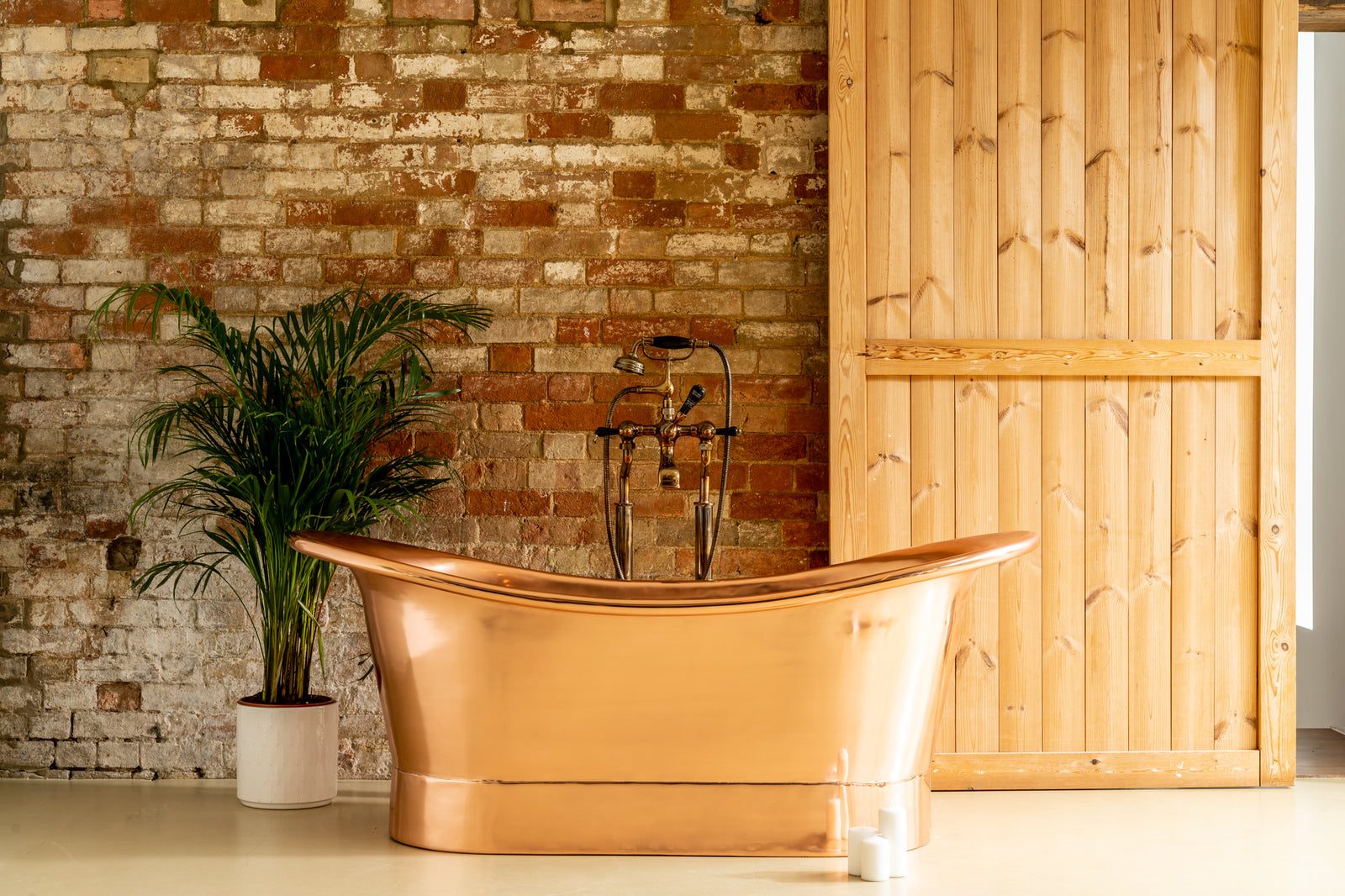





The finish selected for bathroom brassware can completely transform an interior.
Polished (Unlacquered) Brass brings warmth and develops a distinctive natural patina. Polished Nickel provides a brighter, cooler alternative. Aged Brass can give newly installed fixtures an established character, while darker finishes such as Oil Rubbed Bronze introduce depth and architectural contrast.
Yet choosing a bathroom finish involves more than deciding which color looks best on a sample.
Interior designers, architects and homeowners should consider how the finish will interact with marble, cabinetry and lighting; whether it is a living finish; how its appearance may evolve over time; and how consistently it can be specified across luxury bathroom faucets and showers, shower enclosures, bathroom vanities, heated towel warmers, mirrors and accessories.
At Rutland London, our bathroom and heating products are handcrafted to order in England and available in an extensive collection of finishes across Brass, Bronze, Nickel, Copper and Gold tones.
Explore the complete Rutland London Brassware Finishes collection, or continue reading to discover how some of our most distinctive finishes can be used throughout a luxury bathroom.
Why Bathroom Brassware Finishes Matter
Bathroom brassware may represent a relatively small proportion of the physical surfaces within a room, but its visual influence can be considerable.
Faucets sit prominently against marble and porcelain. Shower controls and showerheads are displayed against large expanses of stone or tile. A framed shower enclosure can introduce metalwork across much of the room, while a brass vanity stand or heated towel warmer can turn the same finish into a recurring architectural detail.
When these elements are considered together, the brassware finish becomes one of the materials that defines the bathroom.
This is why finish selection should ideally take place relatively early in the design process rather than being treated as a final decorative decision.
Choosing from a coordinated collection also makes it easier to carry the same finish across bathroom faucets and shower fittings, brass shower enclosures, bathroom vanities and sinks, luxury heated towel warmers and bathroom mirrors.
What Is a Living Finish?
One of the most important concepts to understand when specifying luxury bathroom brassware is the living finish.
A living finish is deliberately allowed to change in appearance over time.
Rather than being completely isolated beneath a surface designed to keep the appearance permanently static, the finish responds naturally to handling, moisture, cleaning, atmosphere and the environment in which it is installed.
This gradual evolution is known as patination.
The result is not perfectly uniform. Areas that are touched regularly may evolve differently from areas that are rarely handled, while the bathroom environment itself can influence the way the finish develops.
Rutland London identifies many of its handcrafted finishes as living finishes, including Polished (Unlacquered) Brass, Brushed (Satin) Brass, Aged Brass, City Bronze and Oil Rubbed Bronze.
What Is Patina?
Patina describes the gradual change that occurs on the surface of certain metals and finishes over time.
On luxury bathroom brassware, this may result in changes in tone, reflectivity and surface character.
Patina should not automatically be confused with deterioration. With a living finish, natural variation is an expected characteristic of the material.
Two identical faucets installed in different homes may therefore develop differently depending on handling, humidity, cleaning routines and other environmental conditions.
For many designers and homeowners, that individuality is precisely the attraction. A living finish develops alongside the interior rather than remaining visually frozen.
Polished (Unlacquered) Brass
Polished (Unlacquered) Brass is perhaps the definitive living bathroom finish.
When newly finished, it has a bright, highly polished appearance with the unmistakable warmth of natural Brass.
Because the surface is unlacquered, however, it is free to react naturally with its environment. Over time, the brightness softens and the finish develops a deeper, more individual patina.
Frequently handled areas can evolve more quickly, helping faucets, shower fittings and other bathroom brassware acquire the character traditionally associated with architectural Brass.
For designers, this means Polished (Unlacquered) Brass should be specified with an understanding that the appearance installed on day one is not intended to remain unchanged forever.
That evolution is part of its appeal.
If you are considering this finish for a project, we strongly recommend ordering a physical Polished (Unlacquered) Brass sample before finalizing the specification.
What Materials Work With Polished (Unlacquered) Brass?
Polished (Unlacquered) Brass is exceptionally versatile.
It works beautifully with white and gray marble, but can be equally striking alongside richly colored natural stones. Dark timber creates contrast against newly polished Brass, while painted cabinetry can produce a more traditional English aesthetic.
Within contemporary interiors, Polished (Unlacquered) Brass can introduce warmth against restrained stone, plaster and glass surfaces.
It can also be carried consistently through Brass Bathroom Faucets & Showers, a Brass Shower Enclosure, a brass vanity stand and a coordinating heated towel warmer.
Brushed (Satin) Brass
Brushed (Satin) Brass offers the natural warmth of Brass with a softer, less reflective surface.
The satin appearance can feel quieter than a highly polished finish, making it particularly useful where the designer wants the metalwork to complement rather than dominate the wider material palette.
Brushed (Satin) Brass works especially well alongside natural marble, limestone, timber and textured wall finishes.
It can also provide an elegant bridge between traditional bathroom fittings and more contemporary architecture.
For larger bathrooms containing significant amounts of visible metalwork, the reduced reflectivity can create a particularly sophisticated effect.
Aged Brass
Aged Brass provides the warmth and character associated with matured Brass from the beginning of the installation.
Rather than starting with the brightness of Polished (Unlacquered) Brass, its surface has greater tonal variation and depth.
This can make Aged Brass particularly effective where newly manufactured fixtures need to sit naturally alongside established materials, richly veined stone, dark timber or layered decorative interiors.
Aged Brass is not restricted to traditionally styled bathrooms. Against restrained contemporary stonework, its warmth and variation can provide an attractive contrast with cleaner architectural lines.
Our Studio 9 Design bathroom project demonstrates how Aged Brass can be carried through faucets, a shower set, heated towel warmer, mirror, towel bar and exposed plumbing to create one coherent material language.
Antique Brass
Antique Brass offers another interpretation of a deeper and more established Brass finish.
Its character can work particularly well with warmer marble, natural timber and traditional cabinetry.
Antique Brass can also complement Georgian, Victorian and other classical architectural influences, while still working within transitional interiors when paired with simpler forms.
Because Aged Brass and Antique Brass have distinct surface characters, physical samples are particularly useful when comparing the two.
Browse the complete Finish Sample collection to compare different options alongside your project materials.
Polished Nickel
Polished Nickel provides a cooler alternative to Brass while retaining a beautifully reflective surface.
Its character is subtly warmer than Chrome, which can make it particularly effective within interiors where designers want brightness without the colder appearance associated with some highly contemporary finishes.
Polished Nickel works beautifully alongside Carrara and other pale marbles, white sanitaryware, painted cabinetry and traditional bathroom furniture.
It is equally at home in traditional and transitional interiors.
For designers seeking a classic metal finish without introducing the golden tones of Brass, Polished Nickel remains an exceptionally versatile choice.
Brushed (Satin) Nickel
Brushed (Satin) Nickel retains the cooler character of Nickel while reducing surface reflectivity.
This produces a softer and more understated appearance.
The finish works particularly well in bathrooms where natural stone, cabinetry or architectural detailing is intended to provide the principal visual interest.
It can also be effective in contemporary and transitional interiors where a highly polished surface might feel too decorative.
Oil Rubbed Bronze
Oil Rubbed Bronze introduces considerable depth and architectural contrast.
Its darker appearance can create a strong outline against white marble, pale limestone and ceramic surfaces.
This makes it especially useful for larger architectural elements such as shower enclosures, where the finish can become an important part of the composition rather than simply a small decorative accent.
Oil Rubbed Bronze can also provide a visual connection to darker lighting, door hardware and furniture details elsewhere within the interior.
For designers who want to extend the finish across the room, Rutland London also offers Oil Rubbed Bronze Bathroom Faucets & Showers and Oil Rubbed Bronze Bathroom Vanities & Sinks.
City Bronze
City Bronze offers a distinctive alternative to brighter Brass finishes and very dark Bronze tones.
Its depth can be particularly effective when paired with expressive natural stone, colored tiles and richer interior palettes.
Within a luxury bathroom, City Bronze can be carried across faucets, shower systems, flush plates and other fittings to create a consistent architectural thread.
See how this approach works in practice in our Luxury Bathroom Designed Around City Bronze.
Copper & Gold Finishes
Copper and Gold tones provide designers with further opportunities to move beyond conventional Brass and Nickel.
Copper introduces a distinctive red warmth that can work beautifully with green marble, dark natural stone and warm timber.
Gold finishes offer a more decorative expression and can provide a jewelry-like quality within highly considered luxury interiors.
Both finishes work best when they are treated as deliberate components of the wider material palette rather than introduced as isolated accents.
Explore Gold Bathroom Faucets & Showers or the wider Brassware Finishes collection to compare the available options.
Polished or Brushed Bathroom Brassware?
One of the simplest decisions when selecting bathroom brassware is whether the surface should be polished or brushed.
Neither is inherently more luxurious.
The correct choice depends upon the character of the room.
Polished finishes reflect more light and tend to draw greater attention to the shape and detailing of the fitting.
Brushed or Satin finishes are quieter and can feel softer against natural materials.
Within a highly decorative bathroom, a Brushed finish can prevent the brassware from competing with expressive marble or wallpaper. Within a restrained interior, a Polished finish can introduce brightness and become a deliberate focal point.

How to Choose a Bathroom Brassware Finish
The best finish is rarely selected in isolation.
Instead, consider the entire material palette of the bathroom.
- Natural marble and stone
- Cabinetry and timber finishes
- Wall colors
- Flooring
- Lighting
- Door and cabinet hardware
- Mirror frames
- Existing architectural metalwork
- The desired level of contrast
- Whether natural patination is desirable
A physical sample should ideally be viewed alongside the actual materials being specified for the project.
Lighting is particularly important because the same metal surface can appear noticeably different under warm artificial lighting, cooler illumination and natural daylight.
You can browse and order from the complete Rutland London Finish Sample collection.
Matching Brassware With Marble
Natural marble and handcrafted metalwork are natural companions.
The challenge is selecting a combination that allows both materials to contribute to the interior.
White & Gray Marble
Pale stones provide enormous flexibility.
Polished (Unlacquered) Brass introduces warmth, Polished Nickel creates a cooler classical aesthetic, while Oil Rubbed Bronze provides dramatic contrast.
Green Marble
Green marble works beautifully with warm finishes such as Aged Brass, Antique Brass, Polished (Unlacquered) Brass and Bronze.
The combination of green natural stone and warm metal can create an especially rich and established interior.
Black Marble
Darker stones can support both high-contrast and tonal combinations.
Polished (Unlacquered) Brass or Gold can stand dramatically against black marble, while Bronze can create a quieter and more architectural relationship.
Highly Veined Marble
Where the stone already provides significant movement and color, a more restrained metal finish can help maintain balance.
Brushed (Satin) Brass, Brushed (Satin) Nickel and deeper Bronze finishes can all work particularly well in this context.
Our article on Layering Marble, Brass & Texture in a Luxury Bathroom shows how expressive natural stone and handcrafted metalwork can be balanced within one interior.
Should All Bathroom Fixtures Match?
They do not necessarily have to, but consistency can be extremely powerful.
In a luxury bathroom, the finish selected for the faucets may also appear on the shower controls, shower enclosure, heated towel warmer, vanity stand, mirror and accessories.
Repeating the same finish creates a visual thread throughout the room.
This is particularly effective where several of these elements are visible simultaneously.
Rutland London's broad bathroom collection makes it possible to specify coordinating finishes across Luxury Bathroom Faucets & Showers, Luxury Shower Enclosures, Luxury Bathroom Vanities & Sinks, Luxury Heated Towel Warmers and Bathroom Mirrors.
Can You Mix Metals in a Bathroom?
Absolutely.
A bathroom does not need to contain only one metal finish, but successful mixed-metal interiors tend to feel intentional.
One approach is to establish a dominant finish for bathroom brassware and introduce a secondary metal through lighting, cabinet hardware or decorative accessories.
Another is to separate finishes according to function.
For example, faucets and shower fittings might share one finish while lighting introduces another.
The key is repetition. If a secondary finish appears only once, it can look accidental. Repeating it elsewhere within the room creates a clearer relationship.
Matching Faucets & Shower Systems
Faucets and shower fittings are usually among the most important products to coordinate.
They often share similar handle designs, proportions and decorative details, and are frequently visible together.
Specifying both from the Luxury Bathroom Faucets & Showers collection makes it easier to carry one finish language between the vanity and showering areas.
Designers can also explore dedicated Shower Sets alongside the wider faucet collection when coordinating a complete bathroom specification.
Matching a Shower Enclosure to Bathroom Brassware
A framed shower enclosure introduces significantly more visible metalwork than a faucet or shower valve.
Its finish therefore deserves particular attention.
A Polished (Unlacquered) Brass frame can create warmth and brightness around pale marble. Aged Brass can give the enclosure greater architectural character. Oil Rubbed Bronze can provide a dramatic outline, while Nickel can create a more restrained appearance.
Explore Brass Shower Enclosures or the complete Luxury Shower Enclosure collection.
Matching a Bathroom Vanity
Open brass vanity stands provide another significant opportunity to repeat the chosen finish.
Because the framework remains visible beneath the marble top, the metal becomes a substantial part of the vanity's appearance.
Matching the vanity to the faucets and exposed plumbing creates a particularly coherent composition.
Explore Luxury Bathroom Vanities & Sinks or our wider Vanities & Sinks collection.
Matching Heated Towel Warmers
A heated towel warmer can contain a considerable amount of visible metalwork.
Rather than accepting a generic finish that has little relationship with the rest of the bathroom, designers can specify a towel warmer in a finish that complements the wider brassware scheme.
This is one of the simplest ways to make the bathroom feel more considered.
Explore our Luxury Heated Towel Warmers, including both Traditional Heated Towel Warmers and Contemporary Heated Towel Warmers.
For more detailed specification advice, read our Luxury Heated Towel Warmers Guide.

Matching Bathroom Mirrors & Accessories
Mirrors and smaller accessories are easy to overlook when developing a finish schedule.
Yet a mirror can introduce a substantial metal frame directly above the vanity, making its finish particularly visible alongside the faucets.
Rutland London's Brass Bathroom Mirrors are available across the wider finish collection, allowing designers to coordinate mirrors with vanity stands, faucets, showers and towel warmers.
Likewise, smaller pieces such as towel bars, robe hooks and other accessories can help repeat the chosen finish throughout the room. Explore Bathroom Accessories, Towel Bars & Mirrors.
Bathroom Finishes for Traditional Interiors
Traditional bathrooms naturally suit finishes with warmth, depth and character.
Polished (Unlacquered) Brass is particularly appropriate where the designer wants fittings to develop a natural patina.
Aged Brass and Antique Brass provide a more established appearance from the beginning.
Polished Nickel offers another classic option and can work beautifully alongside painted cabinetry, traditional sanitaryware and white marble.
The objective does not need to be creating a reproduction interior. Traditional metal finishes can work exceptionally well within rooms that combine classical detailing with contemporary architecture.
Bathroom Finishes for Contemporary Interiors
Contemporary bathrooms do not have to rely on Chrome.
Brushed (Satin) Brass can introduce warmth without excessive decoration.
Brushed (Satin) Nickel creates a quieter cool-metal alternative.
Oil Rubbed Bronze or City Bronze can provide strong architectural definition.
Against large-format stone, simple cabinetry and restrained lighting, these finishes can create sophisticated contemporary interiors while retaining the depth and individuality associated with handcrafted metalwork.
How Designers Should Build a Bathroom Finish Schedule
For interior designers and architects, consistency across a project is particularly important.
A finish may need to appear on dozens of individual components across several bathrooms.
This makes it useful to establish the finish schedule before products are ordered.
The schedule should consider:
- Bathroom faucets
- Shower valves, showerheads and hand showers
- Shower enclosure frames and hardware
- Bathroom vanity stands
- Heated towel warmers
- Bathroom mirrors
- Flush plates and toilet hardware
- Exposed P-traps and pipework
- Towel bars and robe hooks
- Other visible bathroom fittings
Considering these elements together reduces the likelihood of unintended finish variations later in the project.
Why Finish Samples Matter
Digital photography can provide a useful indication of color and character, but it cannot perfectly reproduce the appearance of a hand-applied metal finish.
Screen settings, photography, lighting and surrounding materials can all affect how a finish appears online.
A physical sample allows the designer to view the finish alongside the actual marble, paint, timber, wallpaper and other materials being considered for the room.
This is particularly valuable with living finishes, where natural variation forms part of their character.
Browse and order Bathroom Finish Samples, including Polished (Unlacquered) Brass, Brushed (Satin) Brass, Aged Brass, Antique Brass, Polished Nickel, Brushed (Satin) Nickel, Oil Rubbed Bronze and City Bronze.
Hand-Finished in England
Rutland London bathroom brassware is individually finished by skilled craftspeople in Hampshire, England.
This is particularly important when products from several collections are being specified within the same room.
A faucet, shower set, vanity stand, mirror and heated towel warmer may be very different products, but the finish provides the visual connection between them.
Explore the full Brassware Finishes collection to see the breadth of finishes available across Rutland London's bathroom and heating products.
Frequently Asked Questions About Bathroom Brassware Finishes
What is Polished (Unlacquered) Brass?
Polished (Unlacquered) Brass is polished natural Brass without a lacquer coating intended to keep its appearance static. It begins bright and reflective before gradually developing patina through handling, moisture and exposure to its environment.
Does Polished (Unlacquered) Brass change color?
Yes. Its appearance naturally evolves over time. This change is an expected characteristic of the living finish rather than a defect.
What is the difference between Polished (Unlacquered) Brass and Brushed (Satin) Brass?
Polished (Unlacquered) Brass has a brighter and more reflective surface, while Brushed (Satin) Brass has a softer satin appearance. Both provide the warmth and character associated with Brass.
What is the difference between Aged Brass and Antique Brass?
Both provide a deeper, more established appearance than newly polished Brass, but each has its own tone and surface character. We recommend comparing physical finish samples alongside the materials being used within the project.
Is Polished Nickel the same as Chrome?
No. Nickel and Chrome are different finishes and have different visual characteristics. Polished Nickel typically presents a subtly warmer character than Chrome and will also develop its own surface character over time.
What bathroom brassware finish works best with marble?
There is no single correct finish. Pale marble works beautifully with Brass, Nickel and Bronze, while richer green and dark stones can pair particularly well with warmer or deeper finishes. The wider material palette should determine the final choice.
Can I mix Brass and Nickel in the same bathroom?
Yes. Mixed metals can work extremely well when the combination is intentional and each finish is repeated sufficiently to feel like part of the design.
Should my shower enclosure match my faucets?
It does not have to, but matching or deliberately coordinating the finishes can create a much more cohesive bathroom. Rutland London offers custom shower enclosures alongside coordinated faucets and shower fittings.
Can my heated towel warmer match my faucets?
Yes. Rutland London's heated towel warmers are available in an extensive selection of handcrafted finishes, allowing them to coordinate with faucets, shower fittings and other bathroom brassware.
Can my vanity match my bathroom fixtures?
Yes. Rutland London Luxury Bathroom Vanities & Sinks can be specified in coordinating metal finishes to create continuity between the vanity, faucets, shower fittings and other architectural metalwork.
Do living finishes require maintenance?
Living finishes require appropriate care and should be expected to change naturally. Cleaning methods should always be suitable for the particular finish, and abrasive or aggressive chemical cleaners should be avoided unless specifically recommended.
Can I order bathroom finish samples?
Yes. Rutland London offers a comprehensive collection of physical bathroom finish samples, which we strongly recommend reviewing alongside marble, timber, paint and other materials before completing a specification.
Choosing the Right Finish for Your Bathroom
There is no universal best bathroom brassware finish.
The right choice depends upon the architecture, materials and atmosphere of the individual room.
Polished (Unlacquered) Brass offers warmth and natural evolution.
Brushed (Satin) Brass provides a quieter interpretation of the same material.
Aged Brass and Antique Brass introduce depth and established character.
Polished Nickel and Brushed (Satin) Nickel provide cooler alternatives.
Oil Rubbed Bronze and City Bronze provide architectural contrast.
Copper and Gold tones allow designers to explore richer and more decorative palettes.
More important than following a particular trend is choosing a finish that works naturally with the materials surrounding it and can be carried consistently across the bathroom.
Explore Rutland London Bathroom Finishes
Rutland London creates handcrafted bathroom and heating products for architects, interior designers and homeowners throughout the United States.
Our extensive finish collection allows the same design language to continue across faucets, shower systems, shower enclosures, bathroom vanities, heated towel warmers, mirrors and accessories.
- Bathroom Brassware Finishes
- Order Finish Samples
- Luxury Bathroom Faucets & Showers
- Luxury Shower Enclosures
- Luxury Bathroom Vanities & Sinks
- Luxury Heated Towel Warmers
- Bathroom Mirrors
- Studio 9 Design: A Bathroom in Aged Brass
- Design Inspiration: A Bathroom in City Bronze
Specify Your Bathroom Finish With Confidence
Selecting the right finish is one of the decisions that brings a luxury bathroom together.
Rather than considering each fixture independently, architects and designers can establish a complete finish palette across the vanity, faucets, shower fittings, enclosure, heated towel warmer, mirror and accessories.
Start by exploring our luxury Brassware Finishes and ordering the relevant physical finish samples for your material palette.
For projects requiring additional specification assistance or a near-match to an existing finish, contact Rutland London to discuss the requirements of your project.