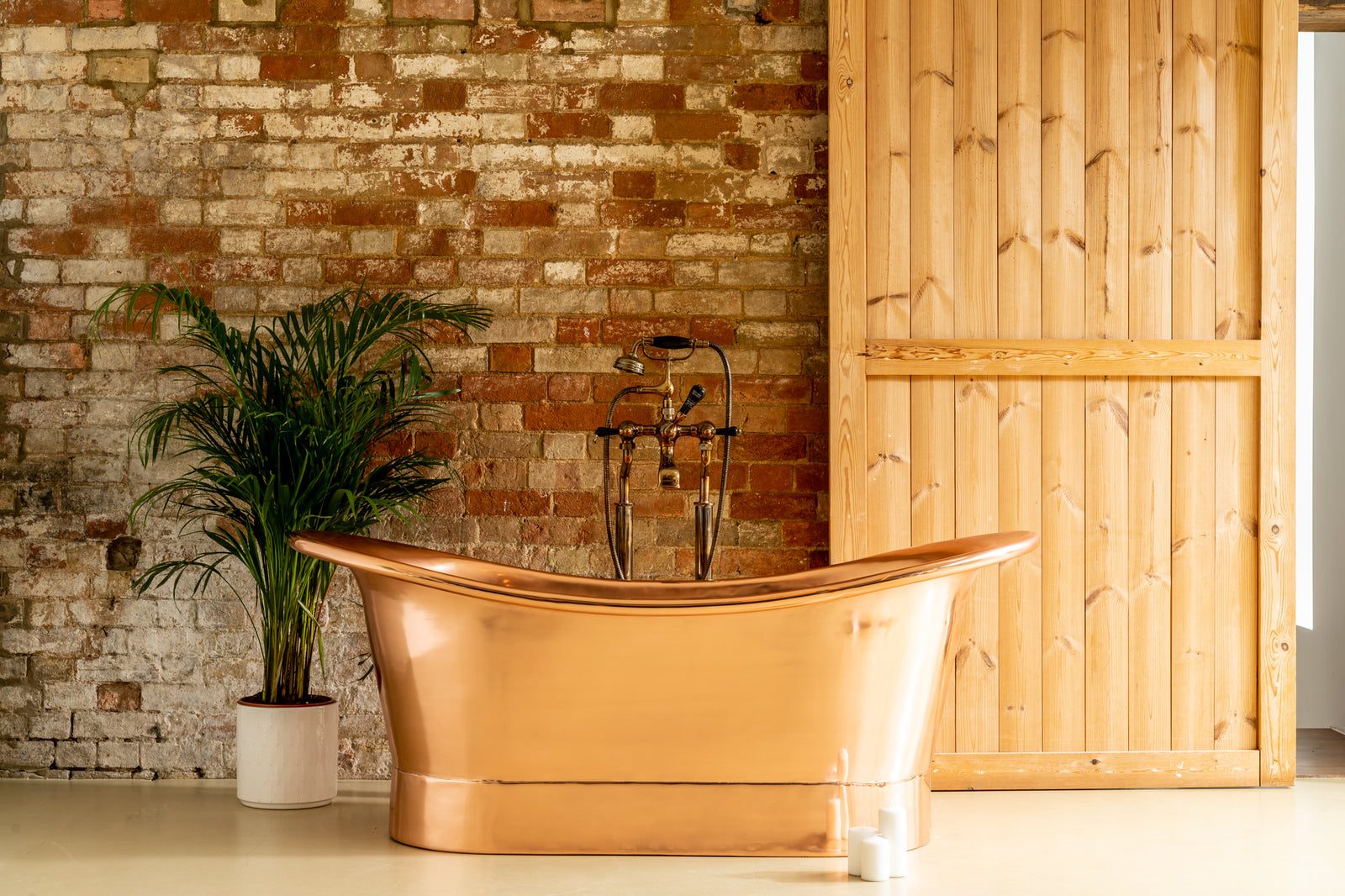





A heated towel warmer is one of those bathroom details that can quickly become difficult to live without.
Warm, dry towels after a shower or bath introduce an everyday sense of comfort, but a beautifully designed towel warmer can do considerably more than simply heat towels. In a carefully considered bathroom, it can become part of the architecture of the room, coordinating with faucets, shower fittings, vanity hardware and other visible metalwork.
For American bathrooms, electric heated towel warmers are particularly useful because they can operate independently without requiring a hydronic heating system.
Rutland London's Luxury Heated Towel Warmers are handmade to order in Hampshire, England from DZR brass with hand silver-soldered joints. Selected designs can be specified as standalone hardwired electric towel warmers, as well as hydronic and dual fuel configurations.
For hardwired and dual fuel towel warmers supplied to the United States, Rutland London uses a 120V UL-approved electric heating element, allowing traditional English towel warmer design to be incorporated into American residential bathrooms.
This guide explains how electric towel warmers work, whether they require plumbing, where they should be positioned, how they are installed and what to consider when specifying a luxury heated towel warmer for a bathroom in the United States.
What Is an Electric Heated Towel Warmer?
An electric heated towel warmer is a bathroom fixture containing an electrical heating element that warms the towel warmer independently from a hydronic heating system.
This distinction is particularly important in the United States.
Many American homes do not have the type of whole-house hydronic heating circuit commonly found in parts of Europe. Consequently, connecting a traditional towel warmer to a wet heating system may not be practical or even possible.
A standalone electric towel warmer provides an alternative.
Rather than requiring heated water to circulate through the product, an electric heating element provides the heat required to warm the towel warmer and the towels placed upon it.
Do Electric Towel Warmers Need Plumbing?
No. A standalone hardwired electric towel warmer does not require a connection to a hydronic heating system.
This is one of the principal advantages for American bathrooms.
A suitable electrical connection is still required, and installation should always be completed by an appropriately qualified professional in accordance with applicable local electrical codes and the installation requirements of the product.
For renovations where introducing new hydronic pipework would be impractical, electric operation can therefore provide a much simpler way to incorporate a traditional heated towel warmer.
What Is a Hardwired Towel Warmer?
A hardwired towel warmer is permanently connected to the property's electrical supply rather than being connected using a visible plug and receptacle.
For luxury bathrooms, hardwired installation can create a considerably cleaner appearance because unnecessary visible electrical components can be minimized.
This is particularly valuable where the towel warmer is intended to coordinate with carefully specified marble, tile, paneling and architectural metalwork.
Rutland London electric heated towel warmers supplied to the United States are designed for hardwired installation using an appropriate electric heating element.
Are Rutland London Electric Towel Warmers Suitable for 120V?
Yes.
Hardwired and dual fuel heated towel warmers supplied by Rutland London for projects in the United States use a 120V UL-approved electric heating element.
This allows selected Rutland London towel warmers to be specified for American electrical installations while retaining the proportions, materials and traditional manufacturing methods associated with our English-made collection.
Electrical requirements should always be reviewed with the project's electrician before installation.
Why Choose an Electric Towel Warmer?
The principal advantage of an electric towel warmer is independence.
It does not need to rely on a hydronic heating system being present or operating.
This makes electric operation particularly useful for:
- American homes without hydronic heating
- Bathroom renovations where new plumbing is undesirable
- Primary bathrooms requiring year-round towel warming
- Bathrooms using radiant floor heating
- Guest bathrooms requiring independent control
- New-build homes where a towel warmer is being incorporated during the electrical design stage
- Warm-climate properties where space heating is rarely required
In each case, the towel warmer can provide comfort independently from the principal method used to heat or cool the home.
Do You Need Hydronic Heating for a Towel Warmer?
No.
This is one of the most common misconceptions surrounding traditional-style heated towel warmers.
While hydronic towel warmers are available for properties with suitable heating systems, a standalone electric configuration allows many of the same designs to be installed without a hydronic circuit.
This makes an electric configuration particularly relevant to the US market.
Electric Towel Warmer vs Hydronic Towel Warmer
The fundamental difference is the source of heat.
A hydronic heated towel warmer connects to a wet heating system and is warmed by heated water circulating through the product.
An electric towel warmer uses an electrical heating element instead.
Neither configuration is inherently better.
Where a suitable hydronic system already exists, a hydronic towel warmer can integrate naturally into it.
Where no such system exists, electric operation avoids introducing a completely separate wet heating circuit simply for the bathroom towel warmer.
What Is a Dual Fuel Towel Warmer?
A dual fuel heated towel warmer combines hydronic and electric operation.
The towel warmer can be connected to a suitable hydronic heating system while also incorporating an electric heating element.
This allows it to operate independently when the primary heating system is switched off.
Rutland London's Dual Fuel Heated Towel Warmers are handmade to order in England and can be supplied to US projects with a 120V UL-approved electric heating element.
Dual fuel is most relevant to American homes that already incorporate a suitable hydronic system but still require independent towel warming at other times of the year.

Electric Towel Warmer vs Dual Fuel
If the property does not have a hydronic heating circuit, there is generally little reason to introduce one simply to create a dual fuel towel warmer.
In this situation, a standalone hardwired electric configuration can provide the required functionality with a simpler installation.
If a hydronic circuit is already available, dual fuel can offer additional flexibility.
The correct choice therefore depends primarily on the building services already present within the property.
Are Electric Towel Warmers Useful in Warm States?
Absolutely.
A towel warmer should not be confused with conventional space heating.
The primary purpose of many electric towel warmers is to provide warm, dry towels rather than to heat an entire bathroom.
That makes them relevant in warmer climates as well as colder ones.
A primary bathroom in Florida, California, Texas or Arizona may have very little requirement for conventional heating, but stepping out of an air-conditioned bathroom and reaching for a comfortably warm towel can still provide a noticeable improvement to the bathing experience.
Because an electric towel warmer operates independently, its usefulness is not determined by the outdoor temperature.
Do Heated Towel Warmers Heat the Bathroom?
Some can contribute useful heat to a bathroom, but not every towel warmer should be treated as the room's principal heat source.
Heat output varies according to the design and size of the product.
An open brass towel warmer intended primarily to warm and dry towels will behave differently from a model incorporating a substantial radiator insert.
If room heating is an important part of the specification, the heat requirement of the bathroom should be calculated and compared with the declared performance of the selected model.
The towel warmer should not automatically be assumed to replace a conventional radiator or radiant floor heating system.
Electric Towel Warmers & Radiant Floor Heating
Electric heated towel warmers work particularly well in bathrooms with radiant floor heating.
The two products perform different functions.
Radiant floor heating can provide gentle heat throughout the bathroom, while the towel warmer concentrates heat where it is particularly enjoyable: directly onto towels.
Because a standalone electric towel warmer does not need to connect to the floor heating system, each can be specified and controlled according to its own requirements.
This combination is particularly appropriate for luxury primary bathrooms.
Wall Mount Electric Towel Warmers
A wall-mounted towel warmer is often the easiest configuration to incorporate into a bathroom.
It uses otherwise unused wall space and can be positioned close to a shower or bathtub without occupying valuable floor area.
Rutland London's Wall Mount Heated Towel Warmers are handmade to order in England and include traditional, transitional and contemporary designs.
Selected models can be supplied in standalone hardwired electric configurations, with custom sizes available where the architecture requires different dimensions.
Floor Mount Electric Towel Warmers
Floor-mounted towel warmers provide a more substantial architectural presence.
Rather than appearing as an accessory applied to the wall, a floor-mounted towel warmer can read almost like a piece of bathroom furniture.
This can work particularly well in larger primary bathrooms where the scale of the room requires a more substantial product.
Explore Rutland London's Floor Mount Heated Towel Warmers for traditional and contemporary designs available across a variety of heating configurations.
Where Should a Towel Warmer Be Positioned?
The best position is usually somewhere that allows a towel to be reached naturally after bathing or showering.
This sounds obvious, but towel warmer positioning is often considered too late in the design process.
Ideally, the location should be established while the bathroom layout, electrical services and plumbing are still being planned.
Possible locations include:
- Beside a walk-in shower
- Adjacent to a freestanding bathtub
- On a wall opposite the shower
- Between a vanity and shower enclosure
- On a dedicated wall within a large primary bathroom
The product should be conveniently accessible without interfering with doors, shower glass, cabinetry or circulation through the room.

Plan the Electrical Connection Early
For a hardwired electric towel warmer, the position of the electrical connection should be coordinated before the wall or floor finish is completed.
This is particularly important where marble slabs, decorative tile, paneling or other high-value finishes are being used.
Depending on the model, the electric heating element may emerge from a specific position on the towel warmer.
If an alternative element position is required, this should be discussed before manufacture.
Early coordination between the interior designer, contractor and electrician can create a much cleaner finished installation.
Can the Electrical Element Be Hidden?
The electrical installation should be planned to minimize unnecessary visual interruption while remaining compliant with all applicable requirements.
Because the towel warmer itself is often highly decorative, a carefully coordinated hardwired connection helps preserve the architectural appearance of the product.
Selected Rutland London models can also be manufactured with alternative element positions where technically possible, allowing the product to respond more closely to the layout of the bathroom.
Traditional Electric Towel Warmers
An electric heating element does not mean the towel warmer itself needs to look like an electrical appliance.
This is an important distinction.
Many mass-produced electric towel racks use simple contemporary forms because they are designed primarily as appliances.
A traditional electric towel warmer can instead use substantial brass tubing, decorative ball joints, traditional wall plates and carefully proportioned horizontal rails while concealing the modern heating technology within the product.
Rutland London's Traditional Heated Towel Warmers combine this approach with handmade English manufacture.
Contemporary Electric Towel Warmers
For more restrained bathrooms, a simpler towel warmer can provide the same electric functionality with cleaner architectural lines.
Rutland London's Contemporary Heated Towel Warmers include designs intended to sit comfortably alongside modern vanities, large-format natural stone and contemporary shower enclosures.
The heating configuration can therefore be selected according to practical requirements without dictating the decorative style of the bathroom.
Why Brass for a Luxury Towel Warmer?
Material is particularly important on a product that forms such a visible part of the bathroom.
Rutland London heated towel warmers are manufactured from DZR brass tubing rather than being designed as disposable electrical appliances.
Individual joints are hand silver-soldered, with substantial brass componentry used throughout the designs.
The result is a product intended to form part of the permanent architectural metalwork of the bathroom.
Brass also allows the towel warmer to be finished alongside other bathroom fittings, creating a consistent material language throughout the room.
Matching a Towel Warmer to Bathroom Faucets
One of the greatest advantages of treating a towel warmer as bathroom brassware rather than an appliance is the ability to coordinate its finish.
A Polished (Unlacquered) Brass towel warmer can sit alongside Polished (Unlacquered) Brass faucets and shower fittings.
Aged Brass can be repeated across the shower enclosure, vanity hardware and accessories.
Oil Rubbed Bronze can provide greater architectural contrast, while Nickel offers a cooler alternative for white and gray marble bathrooms.
Rutland London towel warmers are available across an extensive collection of more than 40 finishes, including variations of Brass, Bronze, Nickel, Copper and Gold.
Polished (Unlacquered) Brass Towel Warmers
Polished (Unlacquered) Brass is one of the defining Rutland London finishes.
When newly finished, it has a bright, warm appearance that works particularly well against marble, natural stone and traditional painted interiors.
Because it is unlacquered, the surface is a living finish.
Over time, handling, moisture and the surrounding environment will influence its appearance, allowing a natural patina to develop.
This gradual evolution is part of the intended character of the finish.
Aged Brass & Oil Rubbed Bronze Towel Warmers
For interiors requiring greater depth from the outset, Aged Brass and Oil Rubbed Bronze provide alternatives to brighter polished metal.
Aged Brass can work particularly well with warm marble, timber and traditional cabinetry.
Oil Rubbed Bronze creates stronger definition against pale marble, plaster or ceramic surfaces and can coordinate beautifully with darker shower frames and architectural hardware.
The larger scale of a towel warmer means its finish can have a significant influence on the overall material palette of the bathroom.
Nickel Towel Warmers
Nickel provides a cooler alternative to Brass and Bronze.
Polished Nickel can work particularly well with white and gray marble, while Brushed (Satin) Nickel provides a quieter, less reflective appearance.
Where Nickel faucets and shower fittings have already been selected, carrying the same finish onto the towel warmer can help unify the bathroom.
Can an Electric Towel Warmer Be Custom Sized?
Yes, across selected Rutland London designs.
Because the collection is handmade to order, custom dimensions can be considered according to the requirements of the project.
This is particularly useful in American bathrooms where the available wall width, vanity layout or shower configuration does not correspond neatly with a standard towel rack size.
A taller design can provide greater towel capacity without taking up additional wall width.
A wider towel warmer may better accommodate large bath sheets.
Custom sizing can also allow the proportions of the towel warmer to respond more naturally to a large primary bathroom.
How Many Towels Should a Towel Warmer Hold?
This depends on how the bathroom is used.
A guest bathroom may only need space for one or two towels.
A primary bathroom shared by two people may benefit from a taller or wider model with additional horizontal rails.
Family bathrooms may require still greater capacity.
When comparing designs, it is worth considering the usable spacing between the horizontal rails rather than simply counting the total number of bars.
Generous spacing can make it easier to hang and remove substantial bath towels.
Should You Choose a Larger Towel Warmer?
Not automatically.
The product should be proportionate to both the room and the number of towels it needs to accommodate.
An oversized towel warmer can dominate a small bathroom, while a very small product may look visually lost within a large primary suite.
Scale should therefore be considered alongside functionality.
In a substantial American primary bathroom with double vanities, a large walk-in shower and freestanding bathtub, a taller floor-mounted towel warmer can provide an appropriate architectural counterpoint.

Can a Towel Warmer Be Used in a Guest Bathroom?
Yes.
Electric operation can be particularly useful in a guest bathroom because the towel warmer can be controlled independently from the rest of the property's heating system.
It can provide a thoughtful hotel-like detail for guests without requiring a dedicated hydronic connection.
A smaller wall-mounted design can often provide sufficient towel capacity while using relatively little wall space.
Electric Towel Warmers for Primary Bathrooms
The primary bathroom is where a luxury towel warmer often provides the greatest everyday benefit.
Positioned beside a shower or bathtub, it can provide warm towels every morning and evening while also becoming a permanent part of the bathroom design.
In larger bathrooms, a substantial floor-mounted towel warmer can help balance the visual scale of double vanities, freestanding tubs and large shower enclosures.
In smaller primary bathrooms, a wall-mounted design can provide the same comfort while preserving floor space.
Electric Towel Warmers for Luxury Hotels & Hospitality
Warm towels have long been associated with luxury hospitality.
A carefully specified electric towel warmer can therefore be equally relevant to boutique hotels, private clubs, spas and high-end residential developments.
Hardwired electric operation can provide an independent solution where incorporating the towel warmer into a central hydronic system is undesirable.
Custom dimensions and coordinated finishes also allow the product to form part of the wider interior design specification.
Is an Electric Towel Warmer Worth It?
For clients who value the experience of a carefully designed bathroom, an electric towel warmer can provide an unusually tangible improvement to everyday use.
Unlike many decorative bathroom features, it is interacted with every day.
The benefit is both practical and aesthetic: towels can be kept warm and dry while the towel warmer itself contributes to the architecture and material palette of the room.
The key is choosing a product that deserves to remain part of the bathroom for the long term.
A Towel Warmer Should Not Look Like an Afterthought
Luxury bathrooms are often specified carefully down to the smallest visible detail.
Natural marble is selected slab by slab. Faucets are chosen in a particular finish. Shower enclosures, vanity hardware and lighting are coordinated deliberately.
The towel warmer deserves the same consideration.
Rather than treating it as an electrical appliance added at the end of a project, specifying the towel warmer alongside the principal bathroom fittings allows its dimensions, finish, location and electrical requirements to become part of the design from the beginning.
Handmade in England for American Bathrooms
Rutland London heated towel warmers are handmade to order at our family-owned factory in Hampshire, England.
Our designs combine traditional English manufacturing techniques with heating configurations suitable for contemporary international projects.
For American clients, selected models can be supplied as standalone hardwired electric towel warmers using a 120V UL-approved heating element.
This allows the character and proportions of an English brass towel warmer to be incorporated into US bathrooms without requiring a conventional hydronic heating system.
Frequently Asked Questions About Electric Towel Warmers
Do electric towel warmers need plumbing?
No. A standalone hardwired electric towel warmer does not require connection to a hydronic heating system. It does require an appropriate electrical connection installed in accordance with applicable requirements.
Can you have a towel warmer without hydronic heating?
Yes. A standalone electric towel warmer uses an electrical heating element and can therefore operate without a hydronic heating circuit.
Are Rutland London towel warmers 120V?
Hardwired and dual fuel towel warmers supplied by Rutland London for projects in the United States use a 120V UL-approved electric heating element.
Are electric towel warmers hardwired?
Rutland London electric towel warmers supplied to US projects are designed for hardwired operation. The precise electrical requirements should be reviewed with the electrician responsible for the installation.
What is the difference between an electric towel warmer and a heated towel rack?
The terms are often used interchangeably. “Heated towel rack” is commonly used in the United States for a product designed to warm or dry towels, while “heated towel warmer” or simply “towel warmer” describes the same general product category.
Can an electric towel warmer heat a bathroom?
Some towel warmers can contribute heat to a bathroom, but the output of the individual product should be compared with the calculated heat requirement of the room before it is treated as the primary heat source.
Can I use an electric towel warmer with radiant floor heating?
Yes. Radiant floor heating can provide general room heat while the electric towel warmer operates independently to warm and dry towels.
Where should I put a towel warmer?
A towel warmer should ideally be positioned where towels can be reached conveniently after using the shower or bathtub, while maintaining appropriate clearances and complying with applicable installation requirements.
Can I put an electric towel warmer next to a shower?
The towel warmer can be positioned conveniently in relation to a shower, but the precise location of an electrical product within a bathroom must comply with applicable electrical codes, product instructions and required clearances. The position should be confirmed by the project's qualified electrician.
Can an electric towel warmer be custom sized?
Yes. Custom dimensions are available across selected Rutland London heated towel warmer designs, subject to technical and manufacturing requirements.
What finish should I choose for a towel warmer?
The towel warmer can be coordinated with the wider bathroom metalwork. Popular choices include Polished (Unlacquered) Brass, Brushed (Satin) Brass, Aged Brass, Oil Rubbed Bronze, Polished Nickel and Brushed (Satin) Nickel, alongside a wider collection of Brass, Bronze, Nickel, Copper and Gold finishes.
Does Polished (Unlacquered) Brass change color?
Yes. Polished (Unlacquered) Brass is a living finish. Its appearance will naturally evolve as it responds to handling, moisture and the surrounding environment, developing an individual patina over time.
Are electric towel warmers useful in warm climates?
Yes. A towel warmer is primarily about warming and drying towels rather than heating the entire home. Electric towel warmers can therefore provide year-round comfort in warm climates as well as colder regions.
What is a dual fuel towel warmer?
A dual fuel towel warmer can operate using both a suitable hydronic heating system and an electric heating element. This provides independent electric operation when the hydronic system is not in use.
Are electric towel warmers suitable for luxury bathrooms?
Yes. When the towel warmer is selected alongside the faucets, shower fittings, vanity and other architectural metalwork, it can become an integral part of the bathroom design rather than appearing as a separate electrical appliance.
Explore Rutland London Heated Towel Warmers
Rutland London manufactures luxury heated towel warmers for traditional, transitional and contemporary American bathrooms, with electric, hydronic and dual fuel configurations available across selected designs.
- All Heated Towel Warmers
- Wall Mount Heated Towel Warmers
- Floor Mount Heated Towel Warmers
- Traditional Heated Towel Warmers
- Contemporary Heated Towel Warmers
- Dual Fuel Heated Towel Warmers
- Oakley Heated Towel Warmer
- Thurlo Heated Towel Warmer
- Arundel Heated Towel Warmer
- Soho Heated Towel Warmer
Bring the Comfort of an English Heated Towel Warmer to Your Bathroom
An electric towel warmer allows one of the most enjoyable details of a traditional luxury bathroom to be incorporated into American homes without requiring a hydronic heating system.
For renovations, it can avoid unnecessary heating pipework. For new construction, the electrical connection can be incorporated discreetly from the beginning. For bathrooms with radiant floor heating, it can provide dedicated towel warming independently from the room's principal heat source.
Most importantly, the towel warmer can be treated as part of the bathroom design itself.
By coordinating its size, location and finish with the faucets, shower fittings, vanity, shower enclosure and wider architectural hardware, a heated towel warmer becomes much more than a practical accessory.
Explore the complete Rutland London Heated Towel Warmer collection to discover wall mount and floor mount designs handmade to order in England for luxury bathrooms throughout the United States.